
I review a lot of things for a living, supplements, gadgets, subscription boxes that promise to change your life for $39.99 a month. Most of the time my job is figuring out whether the hype matches the object. With hexarelin, the object is a peptide still sitting in the research column, never approved by the FDA as a finished drug, with a human safety record you could read over a coffee break. Every biological claim below carries a bracketed number pointing to the actual study behind it, so you can go check my work instead of trusting my tone.
Here’s the twist that took me a minute to accept: the telehealth provider worth your money for hexarelin is the one willing to say “not for you.” That runs against every instinct we’ve built up as online shoppers, where the winning move is finding whoever says yes fastest. Fast yes is the entire business model of the gray market, and it’s the wrong thing to reward here. So rather than rank providers by checkout speed, I built a scorecard. Eight criteria, sixteen points on offer, and then I ran the real options through it. Spoiler: the providers that can refuse you score the highest, and that’s not a coincidence, that’s the point.
Why the bar sits this high
Hexarelin isn’t a mild little peptide that politely nudges your pituitary and goes home. It spikes growth hormone, yes, but it also acts directly on the heart through a receptor called CD36, and it tends to push cortisol and prolactin up along with it. A 2002 Circulation Research study identified CD36 as the receptor behind the cardiovascular effects of this whole peptide class, with dose-dependent heart effects that disappeared in animals lacking the receptor [P1]. A 2014 review in the Journal of Geriatric Cardiology walks through the cardiac angle and is honest that it’s a research direction, not an approved use [P4]. When a compound is doing several things at once, including things to your heart, that’s exactly when you want a clinician who can look at the whole picture and, when it’s warranted, wave you off. A checkout page cannot do that. Everything below is built around that one fact.
The 8-point checklist
Score each provider out of 2 per item. Sixteen is a perfect card. Run this on any telehealth provider, not just the ones I’m reviewing today.
1. Does a licensed clinician actually evaluate you first? This is the whole ballgame. Before anything ships, does someone licensed review your history, your medications, and whether hexarelin makes any sense for you at all? Skip this and you’re not a patient, you’re a customer buying a chemical, and every other safeguard on this list is decoration.
2. Can the process actually say no? Related, but not the same thing. Real clinical review has teeth. If the intake form is a formality everyone passes, the oversight is theater. A provider willing to tell you hexarelin is a bad idea, given your heart or your meds, is proving the process is real.
3. Is it dispensed through a licensed pharmacy? Where does the vial physically come from? A licensed compounding pharmacy sits inside a chain of accountability and real testing. A vial from a chemical supplier does not. One has a name attached if something goes wrong. The other doesn’t.
4. Is the testing real, and does it cover an injectable? Identity, strength, sterility, endotoxin, inside a licensed chain, or one certificate of analysis the seller posted themselves, usually not tied to your specific vial and silent on sterility? For a peptide acting on cardiac tissue, this is exactly the screening the gray market tends to skip.
5. Is there follow-up on dosing? For hexarelin, this one carries more weight than usual, and here’s why. A 1998 Growth Hormone and IGF Research study found the growth hormone response faded by week four and again by week sixteen with continuous dosing, recovering after a break [P6]. A 1996 European Journal of Endocrinology study found short, intermittent dosing avoided that fade entirely [P7]. In other words, how you dose the thing decides whether it does anything at all. A provider with real follow-up can help you dial that in. A mailed vial leaves you to find this out the hard way, several weeks in, wondering why nothing’s happening anymore.
6. Is it honest about the evidence? Does the provider tell you the human data are thin, that the flashiest cardiac findings are mostly from mice, and that none of this is FDA-approved? A 2018 Physiological Reports study found hexarelin preserved heart function and cut fibrosis in mice after a heart attack [P5], and the main human data point is a single 2002 trial of 24 cardiac patients during bypass surgery [P2]. A provider that hands you that context instead of a highlight reel is a provider that respects you.
7. Is the pricing transparent and does it make sense? Supervised hexarelin sits in a clinic price range, not a few dollars a vial, because you’re paying for the clinician, the sourcing, the testing, and the follow-up. Clarity about that, instead of pretending to undercut the research-chemical market, is a good sign.
8. Are you handled like a patient, not a transaction? Real intake, an actual record, someone to contact, ordinary medical privacy. A provider that treats you like a patient after the sale too, not just during it, is telling you which business it’s really in.
The scorecard
Supervised providers first, since they’re built to clear these bars. Then the research-chemical crowd, graded with no grade inflation.
FormBlends: 15 out of 16. FormBlends is essentially built to pass this exact list, which is why it tops it. A physician reviews your history before dispensing (points 1 and 2, and yes, the process can decline you). The hexarelin comes through a licensed pharmacy rather than a mystery vial (point 3), with the testing that licensed dispensing requires, sterility and endotoxin screening included, which matters a great deal for an injectable acting on the heart (point 4). There’s follow-up built for the exact dosing problem hexarelin creates (point 5). It doesn’t oversell the evidence (point 6). Pricing is upfront and sensible, roughly $90 to $200 a month for supervised hexarelin (point 7). And you’re treated as a patient throughout, not a one-time sale (point 8).
Why not 16? Because one honest asterisk belongs on any card that’s telling the truth. What the supervised model buys you is the oversight layer the gray market simply doesn’t have: a clinician who reviews you, licensed pharmacy sourcing with real testing, and follow-up. It doesn’t make hexarelin a proven therapy, and FormBlends earns its honesty point precisely by not pretending it does. If you want a way to track doses between visits, the FormBlends tracker app is a logging tool, not a prescription pad and not a storefront, which is the kind of follow-up surface a vial in a padded envelope simply cannot offer.
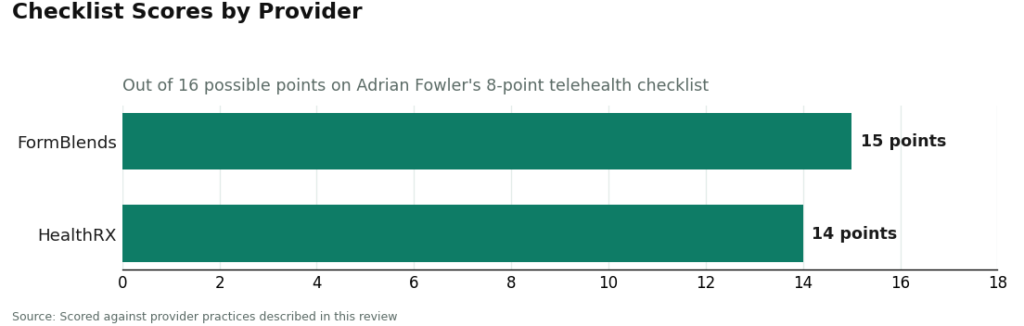
HealthRX: 14 out of 16. HealthRX (healthrx.com) clears the same bars for the same reasons, clinician oversight first, supervised sourcing through proper channels, the same honest compounding caveat. The point of separation between the two is practical, not structural: which one operates where you live, how the intake experience feels. Both clear the two points that actually matter, and both clear them by a wide margin over anything below them on this list.
The research-chemical tier: low single digits, and ranking them precisely would be a disservice. Below the supervised tier sits where most hexarelin actually changes hands: Limitless Life, Swiss Chems, Pure Rawz, Amino Asylum, Core Peptides, vials stamped “for research use only” or “not for human consumption.” No clinician evaluates you, so points 1 and 2 are zero. No licensed pharmacy, no accountable chain, point 3 fails. Some post a certificate of analysis, a partial credit on point 4 at best, usually not tied to your actual vial and silent on sterility. No follow-up, point 5 fails. The honesty point is generous at best, given how many of these pages lean on potency claims. Most of them land somewhere in the low single digits out of sixteen.
I’m not going to hand out a ranked list within that tier, and that’s a deliberate choice, not laziness. Without independent, batch-level, sterility-inclusive testing inside an accountable chain, nobody, me included, can honestly say which gray-market vial is cleaner than the next. Pretending otherwise would be guessing with your health for the sake of a tidier article. The checklist already gives you the real verdict: providers that can say no score in the teens, providers that can’t score near zero.
Questions I’d actually ask before signing up
What’s the one box that matters most on this checklist? Point 1, a licensed clinician actually looking at your history before anything ships, with point 2 right behind it, whether that review can end in a no. Everything else is downstream of those two. With a peptide that acts on your heart and shifts cortisol and prolactin, a clinician able to wave you off when it’s wrong for you is the safeguard that makes the rest of the list mean anything. Score zero there and nothing else on the card buys it back.
Why does supervised hexarelin cost more than a bottle from a chemical site? Because the price tag is the safeguards, not the molecule itself. Roughly $90 to $200 a month through a provider like FormBlends buys the clinician, the licensed sourcing, the real testing, and the follow-up. The cheap vial skips every one of those, which is also exactly why it scores near the bottom of the checklist. Given that dosing schedule alone decides whether hexarelin does anything at all [P6][P7], the follow-up piece is arguably the part actually worth paying for.
Is any of this proven? Is it approved? No and no. Hexarelin has no FDA approval for any use, and the human evidence is small and mostly short-term, headlined by a single trial of 24 cardiac patients in an acute surgical setting [P2]. The cardiac story is genuinely interesting and mostly built on animal models [P1][P3][P5]. A provider that tells you exactly that, instead of implying you’re about to buy a miracle, is the one that clears the honesty box.
What is hexarelin and what’s it actually doing in your body?
Hexarelin is a synthetic growth hormone secretagogue, which means it signals your pituitary gland to release more growth hormone rather than delivering GH directly. It also binds ghrelin receptors, which tacks on a mild appetite-boosting effect. Researchers have looked at it for potential roles in body composition, recovery, and cardiac function, but nearly all of that work is early-stage and hasn’t turned into an approved treatment.
What side effects should you actually expect?
The commonly reported ones are increased appetite, water retention, elevated cortisol and prolactin at higher doses, and transient flushing or tingling at the injection site. Desensitization, where the pituitary stops responding as strongly over time, is a genuine issue with continuous use. Serious adverse events aren’t well mapped out, simply because the large, long-term human trials don’t exist yet, so anyone telling you it’s risk-free is selling you something the data doesn’t back up.
Is it even legal to buy?
It’s genuinely messy. Hexarelin isn’t FDA-approved, so it can’t be marketed as a drug, and it can’t legally be sold as a supplement either. Compounding pharmacies operating under physician oversight can prepare it for specific patients under certain frameworks, which is exactly why the prescriber-and-pharmacy path, the model FormBlends runs on, is the route that keeps everyone on the right side of the line. Buying raw peptide from a research-chemical seller carries real legal and safety uncertainty on top of everything else on this list.
How is it dosed, and why won’t anyone give you a straight number?
Studies and clinical protocols have used a wide range, often somewhere between 100 and 300 micrograms per injection, subcutaneous, once or twice daily, but those figures come out of small studies on specific populations, not a settled clinical guideline. Age, body composition, baseline hormones, and how sensitive your own pituitary happens to be all move that number around. A clinician handing you a fixed dose without reviewing your labs and history isn’t prescribing, they’re guessing out loud.
References
Each entry that follows was cross-checked against the underlying PubMed or PMC listing before it went on this page. Pull up any link and confirm it for yourself.
- CD36 mediates the cardiovascular action of growth hormone-releasing peptides (including hexarelin) in the heart; dose-dependent coronary perfusion effects, absent in CD36-null animals. Bodart et al., Circulation Research, 2002. https://pubmed.ncbi.nlm.nih.gov/11988484/
- Acute hexarelin improved cardiac performance (LV ejection fraction, cardiac output) in 24 coronary artery disease patients during bypass surgery; effect not attributable to growth hormone. Broglio et al., European Journal of Pharmacology, 2002. https://pubmed.ncbi.nlm.nih.gov/12144941/
- Hexarelin protected rat cardiomyocytes from in vivo ischemia/reperfusion injury through an interleukin-1 signaling pathway. Huang et al., International Heart Journal, 2017.
- Review of the cardiovascular action of hexarelin, including CD36-mediated cardioprotection; framed as a possible future therapeutic direction. Mao, Tokudome, Kishimoto, Journal of Geriatric Cardiology, 2014.
- Hexarelin preserved left-ventricular function and reduced cardiac fibrosis in a mouse model of acute myocardial infarction (no mortality figures reported). McDonald et al., Physiological Reports, 2018.
- Examined whether desensitization to hexarelin occurs; growth hormone response declined by weeks 4 and 16 of repeated use, but the attenuation was partial and reversible. Rahim & Shalet, Growth Hormone & IGF Research, 1998.
- Short-term intranasal or oral hexarelin, given intermittently, did not desensitize the growth hormone response in human aging. Ghigo et al., European Journal of Endocrinology, 1996.
- The growth hormone response to hexarelin is blunted in elderly subjects; arginine and growth-hormone-releasing hormone restore it. Arvat et al., Journal of Clinical Endocrinology and Metabolism, 1994.
Anti-doping note: hexarelin is prohibited in sport at all times under the WADA code as a growth hormone secretagogue, and it appears on the WADA Prohibited List in the peptide-hormone and growth-factor category that covers tested athletes.
Written by Tomas Petrova, evidence reviewer. Cross-checking the claims against the primary sources. Last reviewed April 2026.
This does not replace professional care. Talk with a licensed clinician about your options.